Health and Safety Policy for Flat Clearance Hatch End
 Purpose: This Health and Safety policy sets out the core principles and practical measures that govern safe flat clearance operations at Flat Clearance Hatch End. The policy applies across the entire rubbish removal and waste clearance service area, guiding employees, contractors and operatives engaged in domestic and light commercial clearances. It emphasises risk reduction, sound operational controls and the promotion of a safety culture so that every clearance job is carried out with minimal risk to people, property and the environment.
Scope and responsibilities: The policy covers planning, site setup, manual handling, hazardous item management and vehicle loading during waste removal activities. Managers are expected to implement procedures and maintain records. Operatives must follow instructions, use personal protective equipment and report hazards without delay. This document is intended for a rubbish company, waste removal service teams and associated contractors operating within the broader service area and should be read alongside task-specific risk assessments and method statements.

Risk assessment and control measures
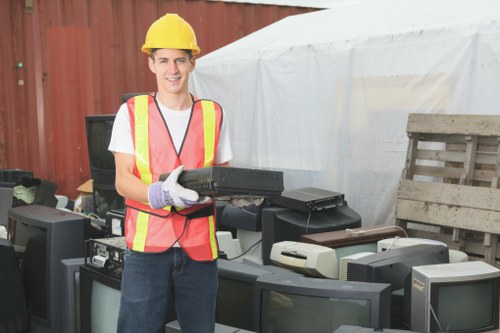
Before any clearance begins, a documented risk assessment will be carried out to identify hazards such as sharps, asbestos indicators, biological waste, trip hazards and manual handling risks. Control measures include clear signage, cordoning where needed, appropriate waste segregation, and use of mechanical aids where practicable. Training will cover safe lifting techniques, use of trolleys and sack barrows, and the correct disposal pathways for mixed refuse, recycling and bulky items to ensure compliance with environmental expectations and reduce injury risk.PPE and equipment: Operatives must wear suitable personal protective equipment including steel-toe boots, high-visibility clothing, gloves and eye protection when necessary. Respiratory protection is to be used when dust or airborne particles are present. Equipment maintenance is essential: all trolleys, lifting straps and vehicles used for rubbish clearance Hatch End operations must be inspected regularly and defects reported. The organisation will ensure provision of adequate tools and safety equipment for every job.
Safe systems of work and task controls
Work will be planned and supervised to maintain safe systems of work. Tasks requiring two-person lifts or mechanical assistance will be clearly identified. The following procedures form part of our standard operating practice:- Pre-job brief and site walk-through
- Segregation of hazardous and non-hazardous waste
- Secure loading and vehicle weight checks
- Waste transfer documentation and chain-of-custody records
Incident reporting and monitoring: All incidents, near-misses and unsafe conditions must be reported immediately and recorded for investigation. A consistent approach to incident investigation will identify root causes and corrective actions. Performance will be monitored using KPIs such as injury frequency, audit results and training completion rates to drive continuous improvement across the rubbish collection service area.
Handling hazardous materials: When waste may contain hazardous substances, the operatives will treat items as potentially dangerous until assessed by competent personnel. Hazardous materials are to be handle with controlled procedures: segregation, secure containment, labelling and transfer to authorised disposal or specialist recycling facilities. Where a substance is suspected to pose a significant health risk, work will stop and competent advice sought before continuation.
 Emergency procedures and first aid: Emergency arrangements include clear evacuation routes, assembly points and access for emergency services. First aid kits, trained first aiders and communication plans are maintained to respond promptly to injuries. Fire risks during clearance operations are minimised by avoiding accumulation of combustible materials and ensuring vehicles carrying refuse are secured and ventilated.
 Training, competence and contractor management: Personnel will receive regular training covering manual handling, PPE, hazardous recognition and safe loading practices. Contractor selection and management processes ensure subcontractors operate to equivalent standards for waste clearance service area work. Records of training, licences and inductions will be maintained and reviewed during procurement and contract supervision.
Environmental considerations: The policy recognises the importance of minimising environmental impact during flat clearances. Waste segregation and recycling are prioritised; disposal follows licensed routes and avoids illegal dumping. Fuel and emissions from vehicles used for rubbish collection are managed through route planning and vehicle maintenance to reduce environmental harm.
Audit, review and continuous improvement: This health and safety policy will be audited periodically to ensure effectiveness and alignment with operational changes in the waste clearance and rubbish removal sectors. Findings from audits and incident investigations will inform policy updates, additional training and procedural changes. Reviews will be undertaken at defined intervals and whenever significant organisational or operational changes occur.
Conclusion: Commitment to safety is essential to the delivery of reliable flat clearance services. Management and staff will work together to maintain a safe working environment throughout the rubbish company service area. By adhering to the controls, training and monitoring set out in this policy, the organisation aims to protect workers, customers and the public while delivering efficient, compliant waste clearance and rubbish collection services.